
Part 1: The Raw Results Athletic Framework
When you watch some of the best athletes in the world compete, what do you actually see?
Take a shortstop ranging into the hole to field a backhand ground ball before throwing a runner out at first.
At first glance, it looks like one athletic movement. In reality, it's dozens of athletic qualities working together in less than two seconds.
The shortstop has to recognize the trajectory of the ball, react, accelerate, decelerate, coordinate multiple body segments, maintain balance, produce force, accept force, throw accurately, and make decisions all while the game continues moving around them.
Most people simply see the play.
I see some of the qualities that made the play possible.
And that's what changed the way I think about training.
Is Strength Enough?
If your goal is to become stronger, then a traditional strength program built around squats, presses, deadlifts, and pull-ups is an outstanding place to start.
Strength matters.
In fact, I believe it's one of the foundational qualities every athlete should develop. But strength alone doesn't automatically make someone more athletic. Sports ask us to do far more than move heavy weight in a controlled environment.
Athletes have to produce force, absorb force, change directions, rotate, react, coordinate movement, recover, and repeat those demands over and over again.
The more I studied athletic performance, the more I realized I wasn't trying to become the strongest person in the weight room.
I was trying to become the most complete athlete I could be.
Looking Back at My Own Training
When I honestly evaluated my own training, I realized my results reflected exactly what I had been practicing.
Most of my time was invested in traditional strength training and baseball-specific skill work.
Not surprisingly, I became stronger.
But there were other qualities I hadn't intentionally developed:
Power
Movement strategy
Coordination
Force acceptance
Mobility
Capacity
Recovery
My results weren't wrong.
They simply reflected where I had invested my time and energy.
That realization completely changed the way I approach training today. Instead of trying to become stronger at all costs, my goal became much simpler:
Become a rotational, efficient, and durable athlete who happens to be strong—not a strength athlete trying to play a rotational sport.
Introducing the Raw Results Athletic Framework
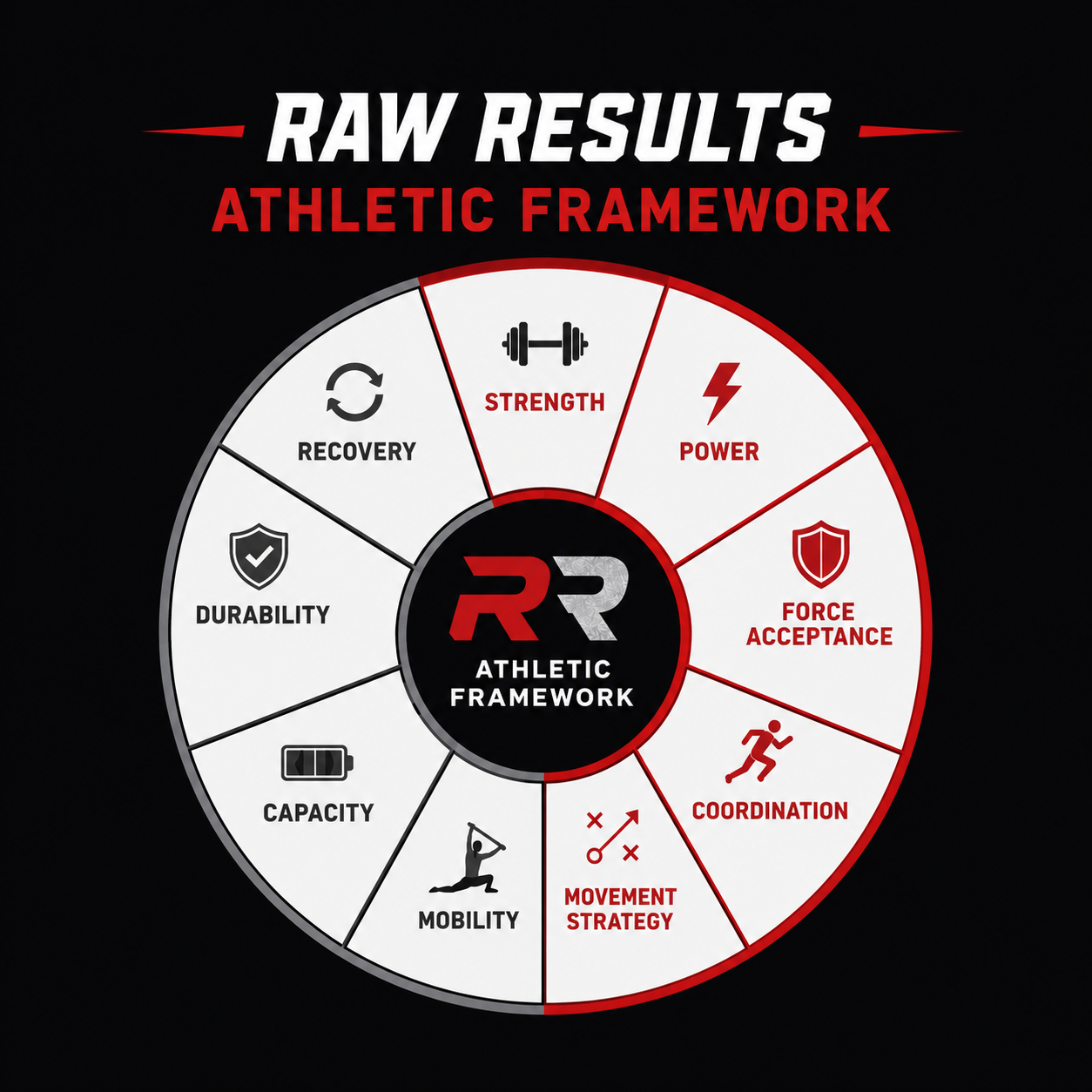
That shift in perspective eventually led me to organize athletic development into what I now call the Raw Results Athletic Framework.
Rather than viewing athleticism as one quality, I see it as the combination of multiple trainable qualities working together.
The framework currently includes:
Strength
Power
Force Acceptance
Coordination
Movement Strategy
Mobility
Capacity
Durability
Recovery
Each quality contributes something different to athletic performance. No single category is responsible for creating great athletes. Instead, the goal is to continually invest in each area based on the athlete's needs, sport, goals, and stage of development.
I often visualize these qualities as pieces of a pie.
If one slice becomes disproportionately large while the others are neglected, the athlete may become exceptional in one area while leaving performance on the table elsewhere.
The objective isn't equal slices.
The objective is intentionally developing the qualities that matter most for the athlete standing in front of you.
Where We're Going Next
This article isn't meant to define every piece of the framework. Instead, it's meant to introduce a different way of thinking about athletic development.
Over the coming articles, we'll take a much deeper look into each of these individual qualities.
We'll discuss:
What they are.
Why they matter.
How they influence athletic performance.
Practical ways to train them.
My hope isn't simply to provide more exercises. It's to help athletes, coaches, and parents better understand why those exercises belong in a program in the first place.
Key Takeaways
Strength is one important piece of athletic development but it isn't the entire picture.
Your current results are often an honest reflection of the qualities you've consistently invested in.
Great athletes develop multiple qualities that work together rather than relying on one area alone.
The Raw Results Athletic Framework is designed to help organize those qualities into a practical model for building more complete athletes.
Thanks for taking the time to read Part 1.
If this article sparked a question or challenged the way you think about training, I'd love to hear from you. Your questions often inspire future articles, videos, and discussions.
Until next time,
Bryan Adames, DPT
Founder | Raw Results Sports Performance
